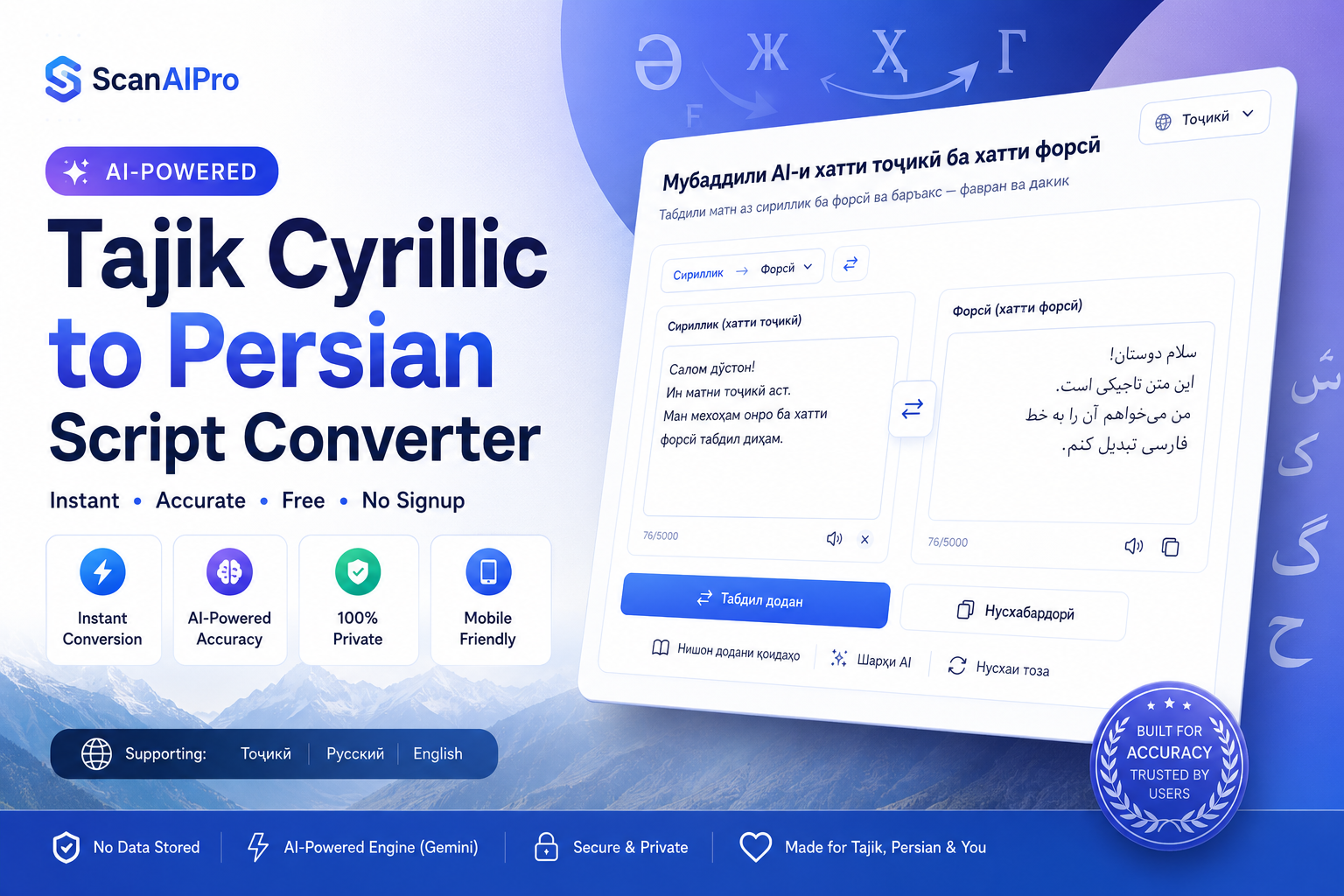
1. How the Tajik Cyrillic Alphabet Maps to Perso-Arabic
The modern Tajik language is written in a modified version of the Cyrillic alphabet consisting of 35 letters. Six of these characters—ғ (غ), қ (ق), ҳ (ح), ҷ (ج), ӣ (ی), and ӯ (و)—were created specifically during script reforms to represent distinct Tajik phonemes not found in standard Russian Cyrillic. Transliterating these symbols into the traditional Perso-Arabic script requires strict positional logic: initial vowels require alif-maddah (آ), medial short vowels are often omitted or marked with kasra/fatha, and final vowels follow specific grammatical endings.
2. Full Alphabet Mapping Table (Cyrillic ⇄ Persian)
The table below outlines the complete letter-by-letter equivalence between the Tajik Cyrillic alphabet and the Perso-Arabic script used across Iran and Afghanistan:
| Cyrillic | Perso-Arabic | Phonetic Name | Pronunciation Guide | Example (Cyrillic ➔ Persian) |
|---|---|---|---|---|
| А а | آ / ا | Alif | Open 'a' as in father | Абраш ➔ ابرش |
| Б б | ب | Be | Voiced bilabial 'b' | Боғ ➔ باغ |
| В в | و / و | Vav | Labiodental 'v' or 'w' | Ватан ➔ وطن |
| Г г | گ | Gaf | Voiced velar 'g' as in go | Гул ➔ گل |
| Ғ ғ | غ | Gain | Voiced uvular fricative 'gh' | Ғам ➔ غم |
| Д д | د | Dal | Voiced dental 'd' | Дарё ➔ دریا |
| Е е | ای / ی | Ye / Izafe | Initial 'ye' or medial vowel | Ерак ➔ ایراک |
| Ё ё | یا | Yo | Diphthong 'yo' as in yarn | Ёр ➔ یار |
| Ж ж | ژ | Zhe | Voiced postalveolar 'zh' as in vision | Жала ➔ ژاله |
| З з | ز / ض / ظ / ذ | Zain | Voiced alveolar 'z' | Замин ➔ زمین |
| И и | ای / ِ | I / Kasra | Short 'i' or izafe ending | Илм ➔ علم |
| Ӣ ӣ | ی | Long I | Stressed final long vowel 'ee' | Тоҷикӣ ➔ تاجیکی |
| Й й | ی | Yotated Y | Semivowel 'y' as in boy | Май ➔ می |
| К к | ک | Kaf | Voiceless velar 'k' | Китоб ➔ کتاب |
| Қ қ | ق | Qaf | Voiceless uvular stop 'q' | Қалам ➔ قلم |
| Л л | ل | Lam | Alveolar lateral 'l' | Лола ➔ لاله |
| М м | م | Mim | Bilabial nasal 'm' | Моҳ ➔ ماه |
| Н н | ن | Nun | Alveolar nasal 'n' | Нон ➔ نان |
| О о | آ / ا | Long O / Alif | Rounded open back vowel 'o' | Оби ➔ آبی |
| П п | پ | Pe | Voiceless bilabial 'p' | Падар ➔ پدر |
| Р р | ر | Re | Alveolar trill 'r' | Рӯз ➔ روز |
| С с | س / ث / ص | Sin | Voiceless alveolar 's' | Се ➔ سه |
| Т т | ت / ط | Te | Voiceless dental 't' | Тоҷ ➔ تاج |
| Ӯ ӯ | و | Long U | Centralized long vowel 'oo' | Дӯст ➔ دوست |
| Ҳ ҳ | ح / ه | Ha | Voiceless glottal 'h' | Ҳаво ➔ هوا |
| Ҷ ҷ | ج | Jim | Voiced affricate 'j' as in joy | Ҷонон ➔ جانان |
| Ч ч | چ | Che | Voiceless affricate 'ch' | Чашм ➔ چشم |
| Ш ш | ش | Shin | Voiceless postalveolar 'sh' | Шеър ➔ شعر |
| Ъ ъ | ع / ء | Ayn / Hamza | Glottal stop separator | Шеър ➔ شعر |
3. Historical Evolution: Why Tajik Uses Cyrillic
For over 1,000 years, classical Persian literature in Central Asia—authored by luminaries such as Rudaki, Ferdowsi, Rumi, and Avicenna—was recorded exclusively in the Perso-Arabic script. Following the creation of the Tajik Soviet Socialist Republic in the 1920s, a major script reform was launched to increase national literacy rates:
- Pre-1928: Perso-Arabic script served as the sole writing system.
- 1928–1940: Transition to the Latin-based Яналиф (Yanalif) alphabet.
- 1940–Present: Adoption of the modified Cyrillic script, adding 6 Tajik-specific extended letters.
Following Tajikistan's independence in 1991, the Language Law recognized the Perso-Arabic script as an essential historical heritage asset. Today, both scripts remain central to Tajik cultural identity (Committee on Language Source).
4. The Izafe (-и) and Hamza (ъ) Orthography Problem
One of the primary challenges in automated script conversion is the Izafe construction—a grammatical particle linking nouns to adjectives or possessive modifiers. In Tajik Cyrillic, izafe is always written explicitly as a final -и (e.g. китоби сурх). In contrast, standard Persian orthography omits the written letter ی and implies the vowel via an unwritten short kasra (کتابِ سرخ). ScanAIPro's engine uses context parsing to accurately format izafe endings without corrupting word roots.
5. Tajik vs Iranian Persian vs Dari: Dialectic Breakdown
Tajik, Iranian Persian (Farsi), and Afghan Dari belong to the same Southwestern Iranian language branch. While mutual intelligibility in spoken conversation exceeds 90%, key differences exist in written form:
- Tajik (Тоҷикӣ): Uses Cyrillic alphabet; incorporates modern technical Russian loanwords (e.g. самолёт, газета).
- Iranian Persian (فارسی): Uses Perso-Arabic alphabet; incorporates French/English technical terms.
- Afghan Dari (دری): Retains archaisms in vowel distinction (e.g. distinguishing e and i).
6. Real-World Transliteration Examples & Case Studies
Below are real-world sentences demonstrating how ScanAIPro converts complex grammatical sentences bidirectionally:
Cyrillic Input: Салом дӯстони азиз! Хуш омадед ба сомонаи мо.
Persian Output: سلام دوستانِ عزیز! خوش آمدید به سامانهٔ ما.
Linguistic Note: The izafe in дӯстони азиз correctly converts to kasra on دوستانِ, while сомонаи receives the proper hamza-ye-ye mark (سامانهٔ).
7. Beginner's Guide: Reading Tajik in Perso-Arabic Script
If you are accustomed to reading Tajik in Cyrillic, learning the Perso-Arabic alphabet requires mastering three main concepts:
- Right-to-Left Directionality: Text reads from right to left, while numerals read left to right.
- Cursive Letter Connections: Most letters change shape based on whether they appear at the initial, medial, or final position of a word.
- Implied Short Vowels: Short vowels (a, e, o) are generally unwritten in daily text unless marked with diacritics.
Frequently Asked Questions (FAQ)
1. Is the Tajik to Persian converter free to use?
Yes, ScanAIPro's converter is 100% free with no registration, subscription, or hidden fees required.
2. Does the converter work offline?
Yes, the core deterministic transliteration engine operates entirely client-side in your web browser without requiring an active internet connection.
3. Is my text data saved or stored on servers?
No, all transliteration processing happens in real-time within your local browser memory. Zero user input text is ever stored, logged, or transmitted to external servers.
4. Can I convert Persian (Perso-Arabic) script back to Tajik Cyrillic?
Yes! Click the 🔄 Иваз кардани самт (Swap Direction) button or swipe horizontally on mobile to switch to Persian ➔ Tajik Cyrillic mode.
5. What is the difference between Tajik, Iranian Persian, and Dari?
They are mutually intelligible varieties of the Persian language family. Tajik is written in Cyrillic in Tajikistan, whereas Iranian Persian and Afghan Dari use the Perso-Arabic alphabet.
6. Why are some converted words highlighted or underlined?
Subtle highlights flag ambiguous izafe particles or homographs where clicking the ✨ Шарҳи AI button can provide an AI-backed context breakdown.
7. How accurate is the AI-powered context mode?
Our dual-layer AI integration (OpenRouter GPT-4o-mini & Google Gemini Flash) analyzes full sentence grammar, achieving near 100% orthographic accuracy on complex literary texts.
8. Is this converter fully mobile-friendly?
Yes, the UI is optimized for mobile viewports (~360px+) with min 44x44px touch targets, sticky convert controls, and gesture support.
9. Are all Unicode Tajik Cyrillic extended characters supported?
Yes, all 6 unique Tajik characters (ғ, қ, ҳ, ҷ, ӣ, ӯ) are fully supported and mapped to their exact Perso-Arabic counterparts.
10. What is the maximum character limit per conversion batch?
You can convert up to 5,000 characters per single batch instantly.
11. How does the converter handle URLs, emails, and English words?
All URLs (e.g. https://...), email addresses, English/Latin words, and Emojis are preserved verbatim without corruption.
12. How does Speech Synthesis (TTS) work?
Click the 🔊 audio icon to listen to text read aloud via the Web Speech API. You can adjust playback speed from 0.8x to 1.2x.
- Wikipedia — Tajik Alphabet & Orthography History: en.wikipedia.org/wiki/Tajik_alphabet
- State Committee on Language and Terminology of Tajikistan: istilohot.tj/zaboni-tochiki
- Encyclopaedia Iranica — Tajik ii. Tajik Persian Language & Literature: iranicaonline.org